
Manual review for non-standard freight
What Counts as Oversized or Heavy Cargo?
Oversized and heavy cargo shipping to Australia covers freight that exceeds the size, weight, shape or handling limits of a normal parcel or standard pallet network. A shipment may be oversized because one side is too long, because the total cubic volume is large, or because a single item is too heavy for normal manual handling.
Examples include machinery, industrial equipment, furniture, steel structures, large crates, engines, production lines and heavy palletised goods. These shipments require accurate packed dimensions and single-piece weights before a route can be selected.
Common project and industrial freight
Suitable Cargo Types
Machinery and equipment
Production machinery, workshop equipment, engines, generators and commercial appliances.
Long cargo
Pipes, profiles, building materials, furniture and components that exceed standard handling lengths.
Heavy pallets
Dense palletised products with a high single-pallet or single-piece weight.
Large crates
Timber or steel cases protecting sensitive equipment during lifting and transport.
Vehicles and mobile equipment
Eligible vehicles, attachments and equipment requiring roll-on, lifting or special securing.
Out-of-gauge cargo
Freight requiring an open top, flat rack or other special container arrangement.
Match equipment to the cargo
Air, Sea and Truck Delivery Options
Sea freight
Sea freight is the main option for heavy and large cargo. Depending on the dimensions, cargo can move as LCL, FCL, open-top, flat-rack or project freight. Special containers require engineering, securing and carrier approval.
Air freight
Air freight can be considered for urgent equipment or parts within airline size and weight limits. Chargeable weight can be high for bulky cargo, and some pieces may require a freighter aircraft or charter review.
Truck and final-site delivery
The Australian delivery vehicle must match the cargo and site. A standard truck may not be suitable when a tail-lift, crane, side-loader, tilt tray or specialised trailer is needed.
See special transport projects, air and sea charter, sea freight and air freight.
The higher space or weight impact can apply
KG vs CBM Charging
Heavy cargo may be priced by weight, while large low-density cargo may be priced by cubic metre or chargeable weight. The selected mode and carrier determine the exact calculation.
| Charging factor | Used when | Information required |
|---|---|---|
| Gross weight | The cargo is dense or the carrier applies weight-based pricing. | Total and single-piece packed weight. |
| CBM | The cargo occupies significant sea-freight space. | Packed length × width × height for every piece. |
| Volumetric weight | Air cargo is bulky relative to actual weight. | Final external dimensions and quantity. |
| Equipment or slot use | Open-top, flat-rack or out-of-gauge cargo occupies additional space. | Drawings, photos, lifting points and over-dimension details. |
A manual quote is required because standard online rates rarely capture lifting, securing, special equipment, route permits or site access.
Single-piece details control the route
Weight, Length and Dimension Limits
Provide the weight and dimensions of every piece, especially the heaviest and longest item. A shipment can be within the total weight limit but still be unsuitable because one crate exceeds forklift, tail-lift, aircraft door, container door or local-delivery limits.
- Longest, widest and highest packed piece
- Heaviest single piece and total gross weight
- Centre of gravity and lifting points
- Whether the cargo can be stacked
- Forklift-pocket or crane-lifting requirements
- Timber packaging and Australian biosecurity compliance
- Photos and technical drawings
Open-top and flat-rack container dimensions can be reviewed on the container specifications page. Final equipment availability and payload limits depend on the carrier and specific container.
Plan unloading before the shipment leaves China
Tail-Lift, Crane and Manual Handling
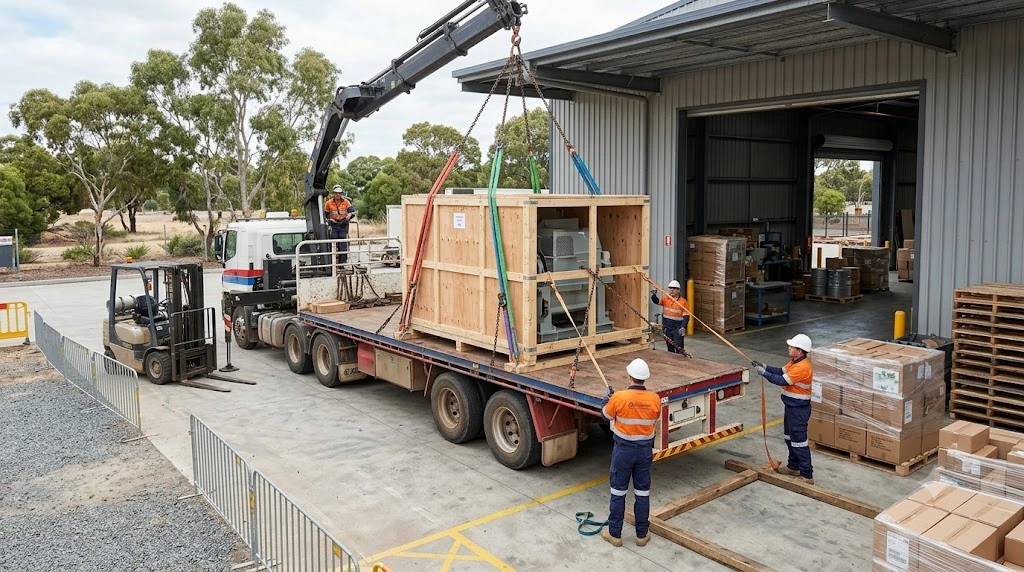
A tail-lift is used for cargo that can be lowered safely from a truck but cannot be unloaded by hand. Very heavy or long pieces may require a crane truck, mobile crane, side-loader, forklift or site lifting team. The receiving location must confirm access, ground conditions, overhead clearances and working space.
Waiting time and failed delivery can be expensive for specialised vehicles. The site contact, delivery window and unloading plan should be confirmed before dispatch. If the destination cannot receive the cargo, delivery to a suitable depot or warehouse may be required.
Customs and biosecurity
Import Compliance for Heavy and Oversized Cargo
Machinery and timber-packaged cargo can attract Australian biosecurity attention. Equipment should be clean and free from soil, plant material, seeds, insects and contamination. Timber packaging must comply with applicable treatment and marking requirements.
The commercial invoice and packing list must accurately describe the equipment, materials, model, use, quantity and value. Used machinery can require additional cleaning or inspection. Review customs clearance and tariff consultancy when classification or permits are uncertain.
Published DDP or volume references can be viewed in the DDP Cost directory, including selected CBM routes such as Sydney-area CBM delivery, Melbourne-area CBM delivery and Brisbane-area CBM delivery. Oversized cargo still requires a manual quote and must not be booked solely from a standard rate page.
Manual project review
Request an Oversized Cargo Quote
Send packed dimensions, total and single-piece weights, photos, drawings, lifting points and the Australian delivery postcode.
Common questions
Oversized and Heavy Cargo FAQ
What information is needed to quote heavy cargo?
Provide packed dimensions, total and single-piece weights, commodity, value, photos, lifting points and the final delivery postcode.
Can oversized cargo be shipped in a standard container?
Only when it fits the internal and door-opening dimensions and remains within payload limits. Otherwise an open top, flat rack or project solution may be required.
Is heavy cargo charged by kilograms or cubic metres?
It depends on the mode and route. Dense cargo may be weight-based, while bulky sea freight may be charged by CBM and air freight may use volumetric weight.
Can you arrange a crane or tail-lift delivery in Australia?
Yes, subject to cargo details, postcode, site access and equipment availability. The unloading plan must be confirmed before booking.
Does used machinery need cleaning before import?
Used machinery should be thoroughly cleaned and free from soil and contamination. Australian biosecurity may inspect or require treatment when concerns are identified.